
Introduction
The 6th Pay Commission Pay Matrix is a commonly searched topic among Central Government employees, pensioners, and those researching ancient government income structures. However, an important technical difference must be understood before looking at revenue figures.
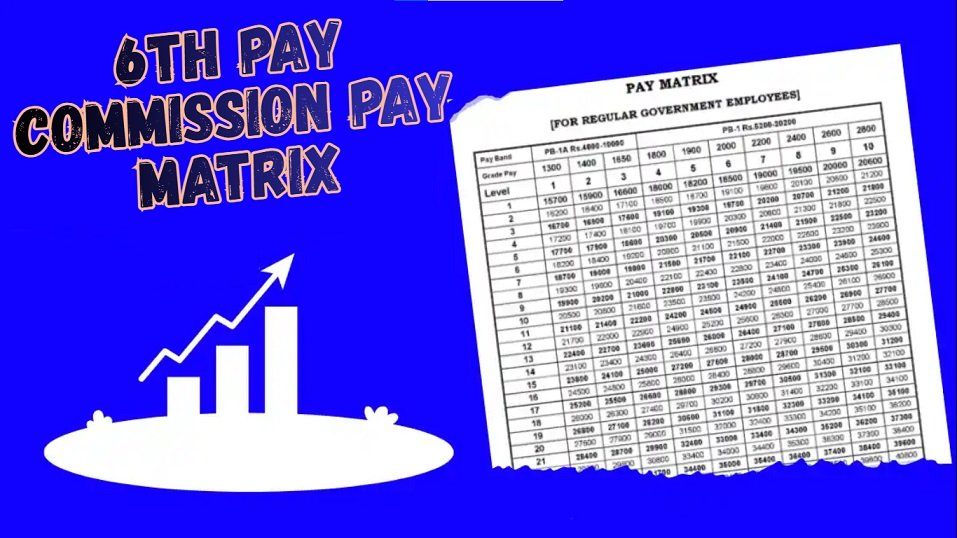
The 6th Central Pay Commission (6th CPC) did not introduce the Pay Matrix in the same shape that exists under the 7th Central Pay Commission. Instead, the 6th CPC introduced a revised pay structure based specifically on Pay Bands and Grade Pay. The Government implemented these recommendations thru the Central Civil Services (Revised Pay) Rules, 2008. The reputable Department of Expenditure archive lists the CCS (Revised Pay) Rules, 2008 among the files implementing the sixth CPC suggestions.
The later 7th Central Pay Commission changed the Pay Band and Grade Pay structure with a Pay Matrix along with ranges and cells. Therefore, whilst a person searches for “6th Pay Commission Pay Matrix,” they may be commonly seeking out the 6th CPC salary structure, pay bands, grade pay, minimum pay, increments, and the method used to revise pay.
This article explains the 6th CPC pay structure in detail and provides beneficial tables for reference.
What Was the 6th Pay Commission?
The 6th Central Pay Commission was constituted to look at and endorse changes in the pay structure, allowances, benefits, and related conditions of service for Central Government employees.
Its recommendations led to a huge restructuring of the existing pay structure. Instead of persevering with numerous man or woman pay scales, the revised structure delivered Pay Bands at the side of Grade Pay for plenty classes of employees.
The revised device became relevant under the CCS (Revised Pay) Rules, 2008, with the revised pay structure normally taking effect from 1 January 2006 in step with the rules.
6th Pay Commission Pay Structure
The key additions of the 6th CPC salary structure have been:
- Basic Pay
- Pay Band
- Grade Pay
- Dearness Allowance
- House Rent Allowance
- Transport Allowance
- Other admissible allowances
The worker’s salary changed into now not understood without a doubt by looking at an old-school person’s pay scale. Instead, the revised basic pay became determined in the relevant Pay Band, whilst Grade Pay was brought in one by one.
Important 6th CPC Pay Bands
The essential civilian pay bands beneath the 6th CPC structure included the following:
| Pay Band | Pay Band Range | Examples of Grade Pay |
|---|---|---|
| PB-1 | ₹5,200–₹20,200 | ₹1,800, ₹1,900, ₹2,000, ₹2,400, ₹2,800 |
| PB-2 | ₹9,300–₹34,800 | ₹4,200, ₹4,600, ₹4,800, ₹5,400 |
| PB-3 | ₹15,600–₹39,100 | ₹5,400, ₹6,600, ₹7,600 |
| PB-4 | ₹37,400–₹67,000 | ₹8,700, ₹8,900, ₹10,000 |
| HAG | ₹67,000–₹79,000 | As applicable |
| HAG+ | ₹75,500–₹80,000 | As applicable |
| Apex | ₹80,000 fixed | Fixed |
| Cabinet Secretary | ₹90,000 fixed | Fixed |
The Government’s later seventh CPC document itself reproduces the pre-revised civilian shape displaying those Pay Bands and Grade Pay combinations.
Note: Pay Band and Grade Pay should not be confused with the 7th CPC’s Pay Matrix Levels. They belong to specific pay systems.
What Is Grade Pay inside the 6th CPC?
Grade Pay become one of the most vital capabilities of the 6th CPC earnings machine.
It became an amount connected to a selected submit or grade and became paid in addition to the employee’s pay in the Pay Band.
For example, an employee could have a particular quantity of pay in PB-1 and a Grade Pay of ₹1,800. The components collectively formed a crucial part of the employee’s primary pay below the revised structure.
The Grade Pay changed into also relevant for determining several pay-related matters, such as the hierarchy of posts and eligibility for certain benefits.
Basic Pay Under the 6th CPC
Under the revised structure, the idea of simple pay was that the pay constant inside the Pay Band plus the applicable Grade Pay.
A simplified illustration is:
Basic Pay = Pay in Pay Band + Grade Pay
For example, if a worker had:
- Pay in Pay Band = ₹8,000
- Grade Pay = ₹2,400
then:
Basic Pay = ₹8,000 + ₹2,400 = ₹10,400
This is the simplest instance of the shape; real pay fixation trusted the relevant guidelines, present pay, and the worker’s instances.
6th Pay Commission Fitment Factor
One of the most vital elements of 6th CPC pay fixation changed to the 1.86 multiplication factor.
Under the revised pay guidelines, the present fundamental pay as applicable for fixation was extended by a factor of 1.86, in accordance with the precise provisions of the guidelines. The ensuing figure was rounded to the subsequent more than one of ten, in accordance with the policies.
For sure upgraded or merged scales, the respective regulations specifically state that existing primary pay as on 1 January 2006 was accelerated by 1.86, with the result rounded to the next multiple of ten, and the relevant Grade Pay was then introduced.
Example of 6th CPC Pay Fixation
Suppose a worker’s present basic pay changed to:
₹10,000
Using the 1.86 factor:
₹10,000 × 1.86 = ₹18,600
If the relevant Grade Pay had been ₹2,400, the ensuing fundamental pay structure could be:
₹18,600 + ₹2,400 = ₹21,000
This is a simplified instance. Actual fixation has to be made in step with the applicable CCS (Revised Pay) Rules and the worker’s particular present scale/pay role.
6th CPC Pay Fixation Formula
The 6th CPC introduced a dependent technique for moving employees from the pre-revised salary structure to the revised Pay Band and Grade Pay device.
A simplified illustration is:
Existing Basic Pay × 1.86 = Revised Pay for fixation
The relevant Grade Pay was then brought in one by one.
However, the real regulations incorporate provisions covering situations which include:
- Upgraded posts
- Merged pay scales
- Employees on deputation
- Employees under suspension
- Stagnation
- Promotion
- Stepping up of pay
- Protection of present emoluments
- Different categories of personnel
Therefore, the easy 1.86 calculation needs to not be treated robotically because the very last earnings for every worker.
6th CPC Increment
The revised pay structure additionally changed the way in which annual increments have been calculated.
Official rationalization issued by the Department of Expenditure states that under the revised pay structure, the rate of increment changed to 3% of the sum of pay inside the Pay Band and Grade Pay, with the resulting amount rounded consistent with the prescribed rule.
This changed into a critical trade because the increment became connected to the employee’s revised pay structure rather than surely following the older scale-based technique.
Simple Increment Example
Suppose:
- Pay in Pay Band = ₹20,000
- Grade Pay = ₹4,200
Total:
₹20,000 + ₹4,200 = ₹24,200
Three percent of ₹24,200 is:
₹24,200 × 3% = ₹726
The applicable regulations are furnished for rounding in the prescribed way.
6th CPC vs 7th CPC Pay Structure
It is crucial to understand the difference between the 2 systems.
| Feature | 6th CPC | 7th CPC |
|---|---|---|
| Main salary structure | Pay Band + Grade Pay | Pay Matrix |
| Grade Pay | Yes | No separate Grade Pay |
| Pay Matrix Levels | No | Yes |
| Cells in matrix | No | Yes |
| Fitment factor | 1.86 for relevant fixation methodology | 2.57 for migration to Pay Matrix |
| Implementation rules | CCS (Revised Pay) Rules, 2008 | CCS (Revised Pay) Rules, 2016 |
| Effective date of revised structure | Generally 1 January 2006 | Generally 1 January 2016 |
The Department of Expenditure’s official circular explains that the 7th CPC introduced the Pay Matrix and used a 2.57 fitment factor for fixation inside the revised structure.
Therefore, the term “6th Pay Commission Pay Matrix” is technically obscure. An extra accurate search term might be “6th CPC Pay Band and Grade Pay” or “6th Pay Commission earnings shape.”
6th CPC Pay Band and Grade Pay Table
The following table provides a useful connection with the major civilian structure:
| Pay Band | Range | Common Grade Pay |
|---|---|---|
| PB-1 | ₹5,200–₹20,200 | ₹1,800 |
| PB-1 | ₹5,200–₹20,200 | ₹1,900 |
| PB-1 | ₹5,200–₹20,200 | ₹2,000 |
| PB-1 | ₹5,200–₹20,200 | ₹2,400 |
| PB-1 | ₹5,200–₹20,200 | ₹2,800 |
| PB-2 | ₹9,300–₹34,800 | ₹4,200 |
| PB-2 | ₹9,300–₹34,800 | ₹4,600 |
| PB-2 | ₹9,300–₹34,800 | ₹4,800 |
| PB-2 | ₹9,300–₹34,800 | ₹5,400 |
| PB-3 | ₹15,600–₹39,100 | ₹5,400 |
| PB-3 | ₹15,600–₹39,100 | ₹6,600 |
| PB-3 | ₹15,600–₹39,100 | ₹7,600 |
| PB-4 | ₹37,400–₹67,000 | ₹8,700 |
| PB-4 | ₹37,400–₹67,000 | ₹8,900 |
| PB-4 | ₹37,400–₹67,000 | ₹10,000 |
How Was Salary Calculated Under the 6th CPC?
A simplified calculation may be understood in numerous ways.
Step 1: Identify Existing Basic Pay
First, the worker’s primary pay within the pre-revised structure needed to be recognized as at the relevant date.
Step 2: Apply the Applicable Fixation Method
The policies furnished for multiplication by means of the prescribed component, which includes the 1.86 component in the unique fixation situations.
Step 3: Round the Result
The policies prescribe rounding to the next multiple of ten for the relevant calculation.
Step 4: Identify the Pay Band
The employee is placed within the relevant Pay Band.
Step 5: Add Grade Pay
The applicable Grade Pay is added to the pay fixed inside the Pay Band.
Step 6: Calculate Allowances
Allowances, including Dearness Allowance and different admissible additives, have then been calculated below the relevant government orders.
This means that basic pay and gross earnings are no longer the same thing.
Difference Between Basic Pay and Gross Salary
Many people looking for the 6th CPC pay matrix need to realize their real monthly salary. It is consequently crucial to differentiate among exceptional pay components.
Basic Pay is the core pay thing decided below the relevant pay structure.
Gross Salary can consist of:
- Basic Pay
- Dearness Allowance
- House Rent Allowance
- Transport Allowance
- Other eligible allowances
At the same time, deductions, including pension contributions, insurance, income tax, and other relevant deductions, can reduce the amount, without a doubt, acquired within the employee’s financial institution account.
Therefore, a worker’s take-home income can’t be determined from Grade Pay by itself.
Dearness Allowance Under the 6th CPC
Dearness Allowance, generally referred to as DA, has become an essential component for personnel continuing under the 6th CPC pay shape.
The Department of Expenditure maintains official orders concerning DA for employees who stay on the 6th CPC Pay Scale/Grade Pay shape. For instance, its facts consist of orders referring especially to personnel continuing to attract pay under the 6th CPC shape.
This is important because some personnel and categories can also stay ruled by legacy pay structures even after the introduction of later pay structures.
Is There a 6th CPC Pay Matrix?
Strictly talking, there has been no 6th CPC Pay Matrix equivalent to the 7th CPC Pay Matrix.
The sixth CPC machine turned into based totally on:
Pay Band + Grade Pay
The 7th CPC, sooner or later, delivered:
Pay Matrix Level + Cell
This difference is specifically critical when looking online due to the fact that many websites use the word “6th Pay Commission Pay Matrix” to explain old pay tables.
For historical revenue studies, the suitable 6th CPC documents are the CCS (Revised Pay) Rules, 2008, relevant Government orders, and the 6th CPC suggestions.
Why Is the 6th CPC Pay Structure Still Important?
Although the seventh CPC is now the present-day Central Government pay structure, the sixth CPC remains applicable for several reasons.
Historical Salary Calculations
Retired employees and pensioners may also need facts about the pay they received under the 6th CPC.
Pension-Related Records
Historical pay facts may be applicable whilst inspecting pension facts and older career files.
Pay Fixation Disputes
Some career topics contain ancient fixation under the sixth CPC guidelines.
Understanding Pay Commission Changes
Studying the 6th CPC allows provide an explanation for how the Government moved from older pay scales to the Pay Band and Grade Pay system and later to the seventh CPC Pay Matrix.
Important Points About the 6th Pay Commission
| Topic | 6th CPC Information |
|---|---|
| Official structure | Pay Band + Grade Pay |
| Revised Pay Rules | CCS (Revised Pay) Rules, 2008 |
| General effective date | 1 January 2006 |
| Important fixation factor | 1.86 in specified fixation methodology |
| Increment rate | 3% of Pay Band Pay + Grade Pay, subject to rules |
| Grade Pay | Added separately to Pay Band pay |
| Pay Matrix | Not part of the 6th CPC structure |
| Later replacement | 7th CPC Pay Matrix |
| Main government authority | Department of Expenditure, Ministry of Finance |
Official Government cloth confirms the 6th CPC implementation through the 2008 revised pay policies and continue separate orders for employees persevering with the 6th CPC pay/Grade Pay structure.
Common Questions About 6th Pay Commission Pay Matrix
What is the 6th Pay Commission Pay Matrix?
Technically, the 6th CPC did not introduce a Pay Matrix. It brought the Pay Band and Grade Pay system. The Pay Matrix was introduced through the 7th CPC.
What turned into the 6th CPC fitment issue?
The usually used fixation issue in the 6th CPC revised pay fixation method changed to 1.86, subject to the applicable rules and instances.
What became the minimum Pay Band below the 6th CPC?
One of the most important civilian Pay Bands was PB-1: ₹5,200–₹20,200, with exceptional Grade Pay amounts connected to posts inside the shape.
What was the Grade Pay machine?
Grade Pay changed into a separate thing delivered to the employee’s pay inside the applicable Pay Band. It was a vital part of figuring out simple pay and the hierarchy of posts.
When did the seventh CPC Pay Matrix update the 6th CPC machine?
The 7th CPC’s revised pay structure changed the Pay Band and Grade Pay machine with a Pay Matrix under the CCS (Revised Pay) Rules, 2016.
Conclusion
The 6th Pay Commission Pay Matrix is a popular search phrase; however, it is critical to apply the best terminology when getting to know government salaries. The 6th Central Pay Commission no longer introduced the Pay Matrix gadget. Its important income reform turned into the introduction of Pay Bands and Grade Pay, implemented thru the CCS (Revised Pay) Rules, 2008.
The most important Pay Bands covered PB-1, PB-2, PB-3, and PB-4, along with better systems including HAG and HAG+.
The 6th CPC also introduced critical methods for pay fixation, which include the 1.86 method in distinct cases and a 3% annual increment technique primarily based on Pay Band pay plus Grade Pay.