
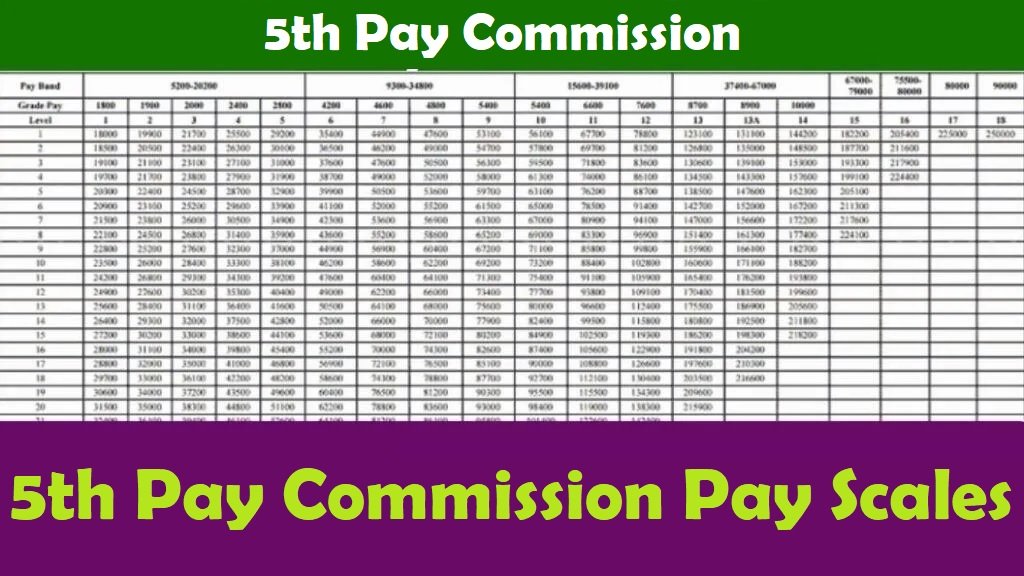
5th Pay Commission Pay Scales
The 5th Pay Commission pay scales are an essential part of the history of Central Government worker salaries in India. The 5th Central Pay Commission was constituted by the Government of India in April 1994 and submitted its document in January 1997. The Government ultimately carried out its guidelines through revised pay rules and associated orders.
The Central Civil Services (Revised Pay) Rules, 1997 were notified on September 30, 1997. The revised structure protected Central Government civilian employees in distinct benefits and integrated revised scales, pay fixation provisions, increments, and different provider-associated modifications. The Government’s decision additionally included important modifications along with a higher fitment benefit and revisions to choose pay scales.
Today, the 5th Pay Commission is mainly applicable for knowledge historic government salaries, antique pension statistics, provider books, ACP-associated subjects, pay fixation, and comparisons with later Pay Commissions. It should not be confused with the contemporary 7th Pay Commission pay matrix.
What Was the 5th Pay Commission?
The Fifth Central Pay Commission (5th CPC) was the 5th foremost Central Pay Commission set up to study the pay structure and service conditions of Central Government personnel.
According to a Government of India background launch, the fee changed into appointed in April 1994 and submitted its record in January 1997. The pronounced monetary effect of the Fifth Pay Commission became about ₹17,000 crore.
The commission examined several regions, which include:
- Pay scales
- Pay fixation
- Dearness Allowance
- Allowances
- Pension and retirement advantages
- Promotion-associated topics
- Service conditions
- Pay structures for special categories of employees
When Did the 5th Pay Commission Pay Scales Apply?
The revised Central Civil Services pay regulations were notified in 1997. For many revised scales, the effective date became January 1, 1996, subject to the applicable guidelines and conditions.
The Government notification contained schedules specifying revised scales for unique posts and classes. It also protected unique provisions for certain posts where restructuring, recruitment-rule modifications, or other conditions had been required earlier than a revised scale could be implemented.
Therefore, when getting to know the 5th Pay Commission, it’s crucial to distinguish between:
- The date on which the commission submitted its document.
- The date the Government issued and implemented guidelines.
- The effective date of a particular revised scale.
- The date on which a worker’s character pay changed to a fixed scale.
5th Pay Commission Pay Scales Table
The following table affords commonly referenced revised scales below the 5th Central Pay Commission. The scale notation shows the starting pay, increments, and maximum pay. For instance, ₹5,000-150-8,000 represents a beginning basic pay of ₹5,000, commonly growing by means of ₹150 per increment until the scale reaches ₹8,000, subject to the applicable policies.
rules.
| 5th CPC Scale | Revised Pay Scale |
|---|---|
| S-1 | ₹2,550-55-2,660-60-3,200 |
| S-2 | ₹2,610-60-3,150-65-3,540 |
| S-2A | ₹2,610-60-2,910-65-3,300-70-4,000 |
| S-3 | ₹2,650-65-3,300-70-4,000 |
| S-4 | ₹2,750-70-3,800-75-4,400 |
| S-5 | ₹3,050-75-3,950-80-4,590 |
| S-6 | ₹3,200-85-4,900 |
| S-7 | ₹4,000-100-6,000 |
| S-8 | ₹4,500-125-7,000 |
| S-9 | ₹5,000-150-8,000 |
| S-10 | ₹5,500-175-9,000 |
| S-11 | ₹6,500-200-6,900 |
| S-12 | ₹6,500-200-10,500 |
| S-13 | ₹7,450-225-11,500 |
| S-14 | ₹7,500-250-12,000 |
| S-15 | ₹8,000-275-13,500 |
| S-16 | ₹9,000 |
| S-17 | ₹9,000-275-9,550 |
| S-18 | ₹10,325-325-10,975 |
| S-19 | ₹10,000-325-15,200 |
| S-20 | ₹10,650-325-15,850 |
| S-21 | ₹12,000-375-16,500 |
| S-22 | ₹12,750-375-16,500 |
| S-23 | ₹12,000-375-18,000 |
| S-24 | ₹14,300-400-18,300 |
These scales are documented in government-associated facts and later reliable references reproducing the fifth CPC scale shape.
How to Read a 5th Pay Commission Pay Scale
The numbers in an ancient pay scale can, to begin with appearance complicated.
Consider this case:
₹5,000-150-8,000
It generally works like this:
- Initial simple pay: ₹5,000
- Increment: ₹150
- Maximum of the scale: ₹8,000
Another instance is:
₹8,000-275-13,500
Here:
- Initial simple pay: ₹8,000
- Increment: ₹275
- Maximum basic pay: ₹13,500
The actual pay development depended on the relevant carrier rules, date of appointment, increments, merchandising, pay fixation and other relevant provisions.
Important 5th CPC Scales for Common Posts
Different government departments assigned exclusive posts to exceptional scales. Therefore, there has been no single fifth Pay Commission pattern for all government employees.
For example, authorities’ statistics display the following varieties of historic scales related to exclusive posts:
| Example of Post/Category | 5th CPC Scale |
|---|---|
| Lower-level Group D categories | ₹2,550-55-2,660-60-3,200 and related scales |
| UDC-type posts | ₹4,000-100-6,000 in some establishments |
| Assistant/Head Clerk-type posts | ₹5,000-150-8,000 in specified categories |
| Office Superintendent-type posts | ₹5,500-175-9,000 or related scales |
| Administrative Officer-type posts | ₹7,500-250-12,000 or ₹10,000-325-15,200 depending on post |
| Senior professional/officer posts | Higher scales such as ₹12,000-375-16,500 and above |
The actual scale turned out to be dependent on the submit, branch, cadre, and applicable notification. The 1997 Gazette notification itself carries published, revised scales and conditions.
5th Pay Commission Group D Pay Scales
Some of the lower historical scales under the 5th CPC covered:
| Scale | 5th CPC Pay Scale |
|---|---|
| S-1 | ₹2,550-55-2,660-60-3,200 |
| S-2 | ₹2,610-60-3,150-65-3,540 |
| S-3 | ₹2,650-65-3,300-70-4,000 |
| S-4 | ₹2,750-70-3,800-75-4,400 |
| S-5 | ₹3,050-75-3,950-80-4,590 |
These figures are specifically beneficial while analyzing antique service statistics, ancient recruitment advertisements, pension documents, or comparisons with later Pay Commission structures.
5th Pay Commission Scales for Clerical and Office Posts
Several clerical and administrative positions were positioned in scales including:
- ₹4,000-100-6,000
- ₹4,500-125-7,000
- ₹5,000-150-8,000
- ₹5,500-175-9,000
- ₹6,500-200-10,500
For example, the 1997 Government notification lists an Assistant in a business enterprise outside the Secretariat at ₹5,000-150-8,000 under the relevant category.
However, a designation by myself need to be used to determine an employee’s historical pay scale. The branch’s recruitment regulations, cadre structure, and unique authority orders additionally mattered.
5th Pay Commission Higher Pay Scales
The commission’s revised structure led to substantially higher officer scales as well.
Examples covered:
| Scale | Pay Range |
|---|---|
| S-15 | ₹8,000-275-13,500 |
| S-19 | ₹10,000-325-15,200 |
| S-21 | ₹12,000-375-16,500 |
| S-23 | ₹12,000-375-18,000 |
| S-24 | ₹14,300-400-18,300 |
These scales illustrate the huge range of the 5th CPC structure, from lower-level positions through senior officer grades. Official and authority facts additionally comprise additional scales and unique scales for specific classes.
Fitment Benefit Under the 5th Pay Commission
One of the considerable aspects of the Fifth Pay Commission implementation was pay fixation and fitment.
The Government’s 1997 resolution states that the fitment advantage became accelerated from 20% to 40% of pre-revised pay, subject to the applicable policies. It also provided safety so that employees obtained as a minimum one increment in the revised scale for every three increments in the vintage scale, in line with the implementation provisions.
This is important due to the fact that the revised simple pay is now, without a doubt, received by taking the maximum or minimum range in a brand new scale.
A worker’s actual revised pay relied on the relevant fixation components and the worker’s present fundamental pay at the applicable date.
5th Pay Commission and Dearness Allowance
Dearness Allowance, normally called DA, became an important part of the pay structure.
The implementation framework is to use the All-India Consumer Price Index for Industrial Workers for determining reimbursement for rate upward push. The Government’s decision made the relevant index base and provisions for DA.
This means that an employee’s total month-to-month remuneration couldn’t be understood genuinely by searching on the basic pay scale.
A broader income calculation should encompass:
Basic Pay + Dearness Allowance + Applicable Allowances = Gross Salary
The actual additives trusted the employee’s position, department, area, and policies applicable at the time.
5th Pay Commission and Railway Employees
Railway employees had their own implementation via the Railway Services (Revised Pay) Rules, 1997.
The Railway Board issued schedules displaying revised scales for specific categories of railway personnel. The record states that the revised scales took effect from January 1, 1996, in line with the applicable guidelines.
Some ancient railway scales included:
| Railway 5th CPC Scale | Revised Scale |
|---|---|
| S-7 | ₹4,000-100-6,000 |
| S-8 | ₹4,500-125-7,000 |
| S-9 | ₹5,000-150-8,000 |
| S-10 | ₹5,500-175-9,000 |
| S-12 | ₹6,500-200-10,500 |
| S-13 | ₹7,450-225-11,500 |
| S-14 | ₹7,500-250-12,000 |
| S-15 | ₹8,000-275-13,500 |
Railway-precise schedules must consequently be consulted while studying a railway employee instead of mechanically applying a well-known Central Civil Services table.
5th Pay Commission Pay Scale vs 6th Pay Commission
The fifth CPC pay scales were later changed with the aid of the 6th Central Pay Commission shape.
The sixth CPC brought Pay Bands and Grade Pay, replacing the antique conventional scale-based structure for maximum Central Government personnel.
For example, ancient government records show:
show:
| 5th CPC Scale | 6th CPC Corresponding Structure |
|---|---|
| ₹2,550-55-2,660-60-3,200 | -1S, ₹4,440-7,440 + applicable Grade Pay |
| ₹2,750-70-3,800-75-4,400 | PB-1, ₹5,200-20,200 + GP |
| ₹4,000-100-6,000 | PB-1, ₹5,200-20,200 + GP |
| ₹4,500-125-7,000 | PB-1, ₹5,200-20,200 + GP |
| ₹5,000-150-8,000 | PB-2, ₹9,300-34,800 + GP |
| ₹8,000-275-13,500 | PB-2/PB-3 treatment depending on the applicable post and provisions |
The actual correspondence may want to vary because the sixth CPC restructuring covered special provisions for distinct posts. The Supreme Court has reproduced the applicable ancient comparison in its dialogue of the later pay structure.
5th Pay Commission and 7th Pay Commission
The 7th Central Pay Commission brought an essentially unique salary structure primarily based on the Pay Matrix and Levels.
Therefore, it is inaccurate to directly deal with a 5th CPC scale which includes ₹5,000-150-8,000 as a modern-day pay scale.
The ancient progression can be understood as:
5th CPC → Traditional Pay Scales
6th CPC → Pay Bands + Grade Pay
7th CPC → Pay Matrix + Levels
This ancient difference is mainly essential whilst getting to know vintage government employment facts.
How Was Pay Fixed Under the 5th CPC?
Pay fixation was governed by using the Central Civil Services (Revised Pay) Rules, 1997, and related orders.
In standard terms, the process takes into consideration:
- The employee’s existing primary pay.
- The relevant revised scale.
- The prescribed fitment gain.
- The relevant increment provisions.
- The date of fixation.
- Promotion or different provider activities.
- Any unique provisions relevant to the unique position.
Because character occasions differed, personnel with distinct posts or provider histories couldn’t always have the equal revised primary pay although their antique pay appeared comparable.
5th Pay Commission Arrears
Implementation of revised pay scales also ended in arrears for eligible intervals.
For employees who have become entitled to revised pay from January 1, 1996, the difference between the quantity already paid and the quantity payable under the revised structure may result in arrears, subject to the applicable implementation orders and deductions.
The Railway Board’s implementation instructions, for instance, discuss calculation and payment of arrears for the applicable period after implementation of the revised railway scales.
Arrears have to consequently be calculated using the specific worker’s pay fixation, allowances, deductions and applicable orders instead of using a widespread components.
5th Pay Commission and Pension
The Fifth Pay Commission also had an enormous impact on pensioners.
Government pension records include orders regarding implementation of the Fifth Pay Commission’s guidelines for pre-1996 pensioners and circle of relatives pensioners, as well as modifications regarding pension revision and Dearness Relief.
Therefore, the 5th CPC is no longer applicable to serving employees; however, additionally to humans gaining knowledge of historic pension and circle of relatives pension calculations.
Why Are 5th Pay Commission Pay Scales Still Important?
Although the 5th CPC scales are historic, they still hold relevance in:
- Old authorities appointment letters
- Service books
- Pension facts
- Historical recruitment notifications
- Court cases
- ACP-related statistics
- Departmental data
- Pay-fixation files
- Old railway facts
- Pension revision documents
- Government files
The scales are also beneficial for understanding how authorities’ income structures advanced before the introduction of the sixth and 7th CPC systems.
Important Points About 5th Pay Commission Pay Scales
| Topic | Important Information |
|---|---|
| Commission | 5th Central Pay Commission |
| Constitution | April 1994 |
| Report submitted | January 1997 |
| Revised Pay Rules | Central Civil Services (Revised Pay) Rules, 1997 |
| Notification date | September 30, 1997 |
| General effective date for revised pay | January 1, 1996, subject to applicable rules |
| Major feature | Revision of traditional pay scales |
| Fitment | Government resolution provided 40% of pre-revised pay, subject to provisions |
| DA | Continued under the revised framework using the prescribed CPI-based mechanism |
| Later structure | Replaced by the 6th CPC structure |
| Current relevance | Historical records, pension, pay fixation and service matters |
The dates and implementation info are supported by Government of India data.
Frequently Asked Questions About 5th Pay Commission Pay Scales
What is the 5th Pay Commission pay scale?
The fifth Pay Commission pay scale refers to the revised income scales added following the guidelines of the Fifth Central Pay Commission and implemented via the Central Government’s 1997 revised pay regulations.
What changed in the 5th Pay Commission scale?
One of the most popular scales within the normally referenced Central Government table changed into S-1: ₹2,550-55-2,660-60-3,200. Different unique classes and provisions could have separate scales.
What changed into the ₹5,000-150-8,000 pay scale?
₹5,000-150-8,000 changed into one of the revised 5th CPC scales, designated as S-9 within the preferred desk. It was changed to be related to numerous posts depending on the branch and applicable regulations.
What became the best fifth CPC scale?
The well-known table contained several higher scales, along with ₹14,300-400-18,300 for S-24. There were also separate higher scales and unique arrangements for unique senior posts and categories, so the answer relies upon whether or not one is discussing the same old table or every unique scale.
Was the 5th Pay Commission powerful from 1996?
The revised pay shape turned into usually implemented from January 1, 1996, subject to the applicable guidelines and specific provisions. The notification implementing the revised guidelines was issued in 1997.
Is the 5th Pay Commission pay scale nonetheless used for modern salaries?
No. The 5th CPC structure ultimately changed with the aid of the 6th CPC, after which the seventh CPC structures. Today, the fifth CPC scales are especially relevant for ancient and report-associated functions.
How can I discover my vintage 5th CPC pay scale?
You must check your appointment order, career e-book, promotion order, departmental recruitment policies, pay-fixation assertion, and applicable Government or department notification. The employee’s designation on its own won’t be sufficient to determine the precise ancient scale.
Conclusion
The 5th Pay Commission pay scales constitute a critical step in the development of India’s Central Government earnings system. The 5th Central Pay Commission submitted its document in January 1997, followed by the implementation of revised pay guidelines in 1997. The revised structure contained severa scales ranging from lower-level scales, which include ₹2,550-55-2,660-60-3,200, to higher scales along with ₹14,300-400-18,300, in conjunction with extra scales and special provisions for unique classes.
For historical studies, it’s miles critical to do not forget that the figures in these tables constitute the fundamental pay scales of the 5th CPC period, not ultra-modern salary amounts. Actual employee pay depended on the subject, branch, date, pay fixation regulations, increments, promotions, and relevant allowances.